

We have all been there: you leave the salon with a flawless, vibrant new shade, only for your roots to peek through just a few weeks later. Or perhaps you tried an at-home box dye, and the tone didn’t turn out quite like the picture on the packaging. Your immediate instinct is to fix it or refresh it right away. But a critical question stops you in your tracks: how often can you dye your hair without completely frying your strands?
Coloring your hair is one of the easiest ways to reinvent your look, boost your confidence, and express your personal style. However, standard hair dyes rely on chemical reactions that alter the structural integrity of your hair. Push the boundaries of safety, and you risk severe dryness, split ends, and chemical breakage.
In this comprehensive guide, we will break down the ideal hair dye frequency, explore how long you should wait between hair coloring sessions based on the type of pigment used, and provide expert-backed strategies for hair coloring maintenance to keep your mane looking glossy and resilient.
What Determines Your Hair Dye Frequency?
When calculating how often I can dye my hair safely, there is no universal, one-size-fits-all answer. Your personal schedule depends on an intersection of several biological and chemical variables.
1. Rate of Natural Hair Growth
On average, human hair grows about half an inch per month. This means that within four to six weeks, you will have a highly visible zone of new growth at your roots. If you are masking gray hair or maintaining a high-contrast color (such as platinum blonde on naturally dark brown hair), your permanent hair dye touch-up schedule will be dictated almost entirely by your hair’s growth rate.
2. The Type of Pigment Formulated
Not all hair color is created equal. The formulations range from temporary color rinses that coat the outside of the hair shaft to aggressive permanent dyes and lighteners that permanently alter the internal protein structure.
3. Current Integrity of Your Hair
Porosity, elasticity, and moisture levels matter immensely. If your hair is already compromised by frequent heat styling, chemical straighteners, or previous bleaching sessions, you will need to stretch out the time between color applications to prevent severe damage.
| Further Reading: |
Understanding Hair Dye Types: How Long Between Hair Coloring?
To establish a safe hair coloring maintenance routine, you must understand the specific type of dye you are applying. Each formulation interacts with the hair cuticle differently, resulting in distinct timelines for safe reapplication.
Semi-Permanent Hair Dye
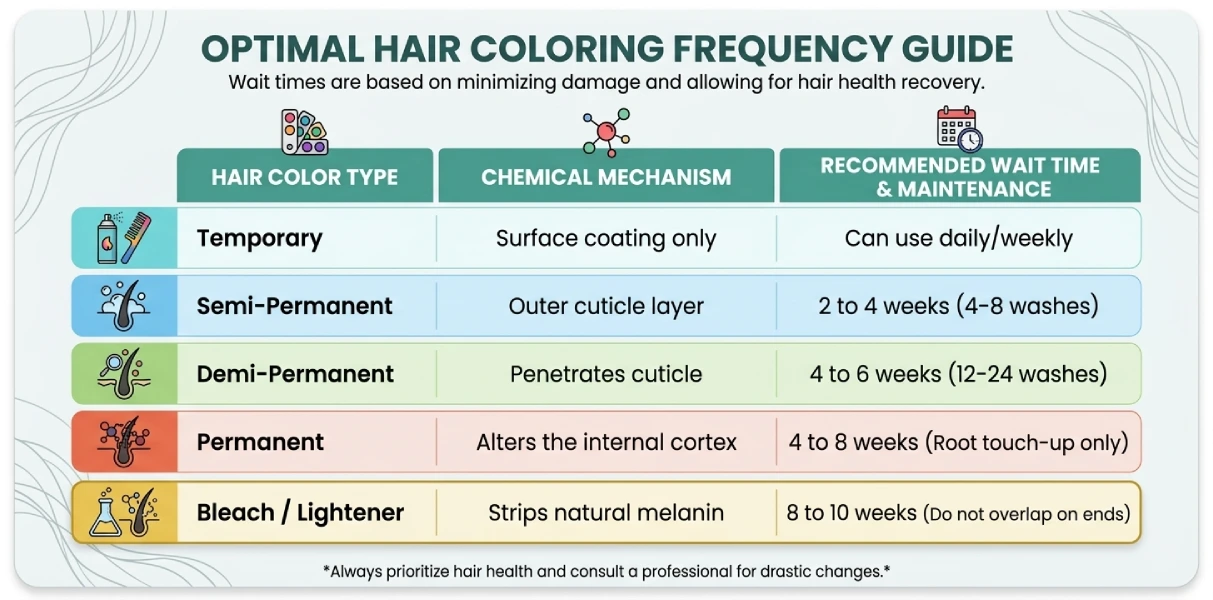
Semi-permanent formulas do not contain ammonia or developer (hydrogen peroxide). Instead of lifting the hair cuticle to deposit color inside, they deposit large pigment molecules directly onto the surface of the hair shaft. Because it merely stains the exterior, it fades progressively every time you wash your hair, typically lasting between 4 to 8 shampoos.
- Safe Frequency: Every 2 to 4 weeks. Because there is no chemical lifting process involved, semi-permanent dye is incredibly low-risk and can be applied frequently without causing structural degradation.
Demi-Permanent Hair Dye
Demi-permanent options occupy the middle ground between gentle glosses and harsh permanent color. They use a low-volume developer (usually around 5 to 10 volume) to slightly open the outer hair cuticle, allowing the pigment to wedge itself just beneath the surface. This color type effectively blends grays and refreshes dull tones, lasting roughly 12 to 24 washes.
- Safe Frequency: Every 4 to 6 weeks. This timeline gives your cuticle ample time to settle and recover from the mild oxidative process.
Permanent Hair Dye
Permanent hair dye relies on alkaline agents (like ammonia) to aggressively raise the protective outer cuticle, followed by a higher-volume peroxide developer that decolors your natural melanin and locks new pigment deep inside the hair’s inner cortex. This process permanently alters your hair structure until it grows out or is cut off.
- Safe Frequency: Every 4 to 8 weeks. When executing a permanent hair dye touch up schedule, you should strictly target the new root growth rather than pulling the permanent formula through to your previously colored ends every time.
Bleach and High-Lift Lighteners
Bleach is not technically a dye; it is an oxidizing agent that dissolves your hair’s natural melanin pigments. This chemical process is highly taxing on the structural proteins (keratin) of your hair.
- Safe Frequency: A minimum of 8 to 10 weeks between sessions, specifically targeting root regrowth. Overlapping bleach on previously lightened hair is the primary cause of extreme chemical breakage.
| Further Reading: |
How Often Can You Dye Your Hair?
To maintain optimal hair health, you should wait a minimum of 4 to 6 weeks between permanent hair coloring sessions. This window allows the hair cuticle to recover and prevents overlapping chemical treatments that cause severe breakage.
Recommended Timelines by Goal:
- Root Touch-Ups (Permanent Color): Every 4 to 6 weeks.
- Semi-Permanent Vivid Tones: Every 2 to 4 weeks.
- All-Over Highlights or Bleach: Every 8 to 12 weeks.
- Gloss or Demi-Permanent Refresh: Every 6 to 8 weeks.
Why Timing Matters: The Science of Hair Damage
To understand how often you should color your hair, it helps to understand what goes on beneath the surface during a chemical color service.
Your hair strand is shielded by an outer layer of overlapping, shingle-like scales called the cuticle. Inside lies the cortex, which houses the moisture, elasticity, and natural pigment of your hair.
When you apply permanent hair dye or lightener, the alkaline formula forces the cuticle scales to flare wide open. While this allows the new color to anchor itself inside the cortex, it leaves the inner core highly vulnerable.
The Compounding Toll of Over-Processing
If you reapply permanent color or bleach too quickly, you engage in a destructive cycle known as over-processing. Because the cuticle hasn’t had adequate time to smooth back down and heal, the subsequent chemical treatment strips away the remaining structural lipids and breaks the essential disulfide bonds holding the protein structure together.
The consequences of ignoring proper hair dye frequency guidelines include:
- High Porosity: The hair cuticle remains permanently stuck open, making it impossible for your strands to retain moisture or even hold onto new color molecules (causing your expensive dye job to rinse right down the drain).
- Loss of Elasticity: When stretched, healthy hair springs back to its original length. Over-processed hair loses this stretch, snapping easily under the minor tension of a hairbrush.
- Trichoptilosis (Severe Split Ends): The damage travels up the hair shaft, turning smooth strands into frayed, straw-like textures that can only be corrected with a haircut.
| Further Reading: |
Common Mistakes to Avoid in Your Hair Color Routine
Even with the best intentions, it is easy to fall into habits that compromise your hair health. Avoid these frequent pitfalls to protect your length:
Overlapping Full-Coverage Color
When your roots grow in, you only need to apply permanent color to that specific half-inch of fresh growth. A common error—especially with at-home box dyes—is dragging the permanent formula from roots to ends during every application. This subjects your mid-lengths and ends to unnecessary, repeated chemical trauma.
Shifting Directly Across the Color Spectrum
Attempting to go from dark espresso brown to icy platinum blonde in a single week is a recipe for hair disaster. Drastic transformations require multiple, carefully spaced sessions to give the hair structural breathing room.
Relying on Box Dyes with High-Volume Developers
Many drugstore box dyes are formulated with excessively high volumes of peroxide developer to ensure they work on a broad range of hair types. Unfortunately, this means you might be using a harsh, damaging formula when your hair only required a gentle touch-up.
| Further Reading:
▶ Perfume in Hair: The Ultimate Guide for a Lasting, Safe, and Pleasant Scent |
Step-by-Step Maintenance Guide: What to Do Between Colorings
Maximizing the time between your color treatments not only saves your hair from chemical wear-and-tear, but it also saves your wallet. Follow this step-by-step framework to maximize your hair coloring maintenance and keep your hue pristine.
Step 1: Use a Root Concealer for Growth Spurts
When you hit the 3-week mark and your roots begin to show, don’t rush to mix a fresh batch of dye. Instead, utilize temporary root touch-up sprays, tinted dry shampoos, or root powders. These wash-out options seamlessly camouflage your natural growth or stubborn grays without imposing any chemical stress on your scalp.
Step 2: Wash Less Frequently and Drop the Temperature
Water is the number one enemy of hair color. Every time your hair absorbs water, the shaft swells, allowing color pigments to slip out.
- Limit washing your hair to 2 or 3 times a week.
- Always use lukewarm or cool water when rinsing. Hot water acts just like a chemical agent, lifting the hair cuticle and stripping away both your color and your natural, protective oils.
Step 3: Swap to Color-Safe, Sulfate-Free Shampoos
Standard shampoos frequently contain harsh surfactants like Sodium Lauryl Sulfate (SLS), which strip away oils and accelerate color fading. Invest in professional-grade, sulfate-free systems specifically formulated to preserve color molecules and reinforce the hair barrier.
Step 4: Integrate a Dedicated Bond-Building Treatment
Modern haircare science has gifted us with bond-building technologies (such as Olaplex, K18, or maleic acid complexes). These treatments work on a molecular level to repair the broken disulfide bonds within the cortex. Incorporating a bond builder once a week drastically improves elasticity between color applications.
Expert Best Practices for Salon-Grade Results
For those committed to coloring their hair over the long term, adhering to these professional-grade best practices will preserve your hair’s natural bounce and shine:
- Prioritize Deep Conditioning: Treat your hair to a deeply hydrating conditioning mask containing hydrolyzed proteins, argan oil, or shea butter at least once a week. This seals the cuticle and gives your hair a reflective, glossy finish.
- Incorporate a Hair Glossing Service: If your color looks dull at the 4-week mark but your roots are still manageable, ask your stylist for a clear or tinted hair gloss instead of a full color service. Glosses are acidic, non-damaging treatments that smooth down the cuticle, boost shine, and neutralize brassiness.
- Protect Strands from Heat Styling: UV rays from the sun and heat from curling irons or straighteners oxidize hair color, causing it to fade prematurely and shift tones. Always mist a premium heat protectant over your locks before using hot tools, and try to keep your styling tools below 180°C (350°F).
| Further Reading: |
FAQs: Your Hair Coloring Questions Answered
How often is it safe to dye your hair?
For permanent hair color, it is generally safe to dye your hair every 4 to 6 weeks. If you are using non-oxidative semi-permanent dyes, you can apply them safely every 2 to 3 weeks since they do not alter the internal structure of your strands.
Can dyeing your hair too often cause damage?
Yes, dyeing your hair too frequently—especially when utilizing permanent dyes, ammonia, or bleach—will cause significant damage. Over-processing permanently degrades the hair’s protective cuticle layer, strips away natural moisture, and breaks internal protein bonds, leading to chronic dryness, frizz, split ends, and severe hair breakage.
How long should I wait between hair coloring sessions?
You should aim to wait a minimum of 4 weeks between standard color touch-ups, though 6 to 8 weeks is highly recommended to preserve optimal hair health. If you are planning a drastic color correction or a heavy bleaching service, extending that waiting window to 8 to 12 weeks is ideal to prevent structural damage.
Does the recommended timing differ for permanent and semi-permanent dye?
Absolutely. Permanent hair dye uses strong chemicals to penetrate deep into the hair’s inner cortex, meaning it requires a strict 4 to 8-week waiting period to prevent over-processing. Semi-permanent dye, on the other hand, merely coats the outside of the hair shaft without lifting the cuticle, allowing you to reapply it safely every 2 to 4 weeks with zero risk of chemical damage.
What can I do to keep my hair healthy between color treatments?
To keep your colored hair healthy, switch to a sulfate-free, color-safe shampoo and rinse your hair with cool water to lock down the cuticle. Additionally, incorporate a weekly deep conditioning mask or bond-building treatment to repair structural damage, minimize heat styling with hot tools, and use temporary root concealers to stretch out the time between your coloring sessions.
Conclusion
Determining how often you can dye your hair is all about balancing your desired aesthetic with the biological realities of your hair’s structural health. While it can be tempting to reach for a fresh box of dye or book a salon visit at the very first glimpse of a gray strand or an uneven undertone, patience is your hair’s absolute best friend.
By waiting a minimum of 4 to 6 weeks between permanent color treatments, focusing exclusively on your root regrowth, and nourishing your strands with bond builders and deep conditioners, you can confidently enjoy a gorgeous, head-turning shade without sacrificing the health and integrity of your hair.
Are you ready to take your hair health to the next level? Talk to your professional stylist about creating a customized color roadmap tailored directly to your specific hair type, and swap out your harsh daily shampoos for a nourishing, sulfate-free routine today!