
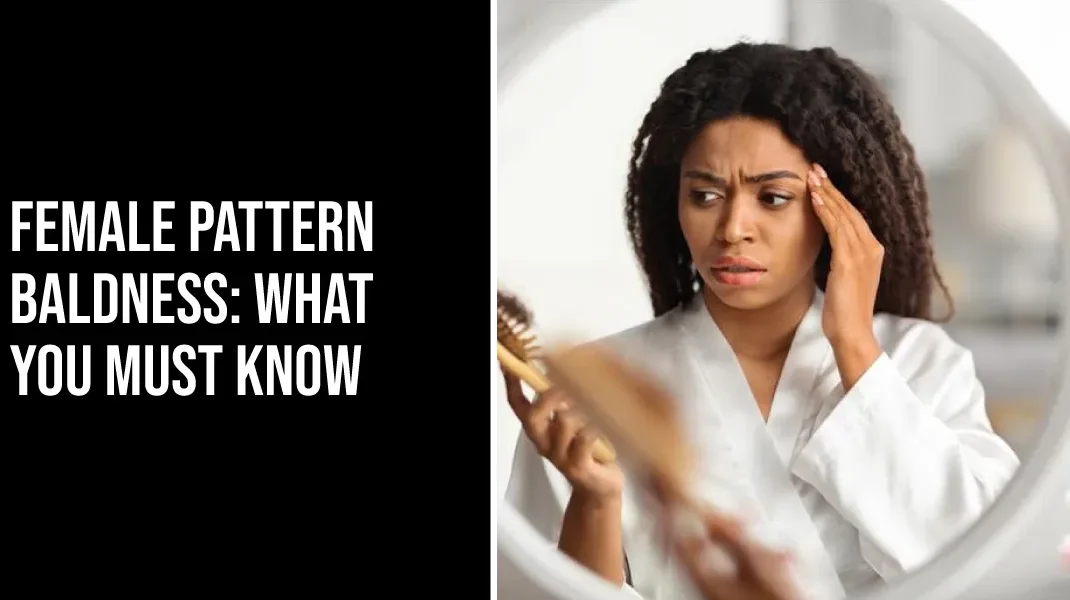
Let’s say you notice small changes first. Your hair part looks a bit wider. Your ponytail feels lighter. You run your fingers through your hair and see a few extra strands. Slowly, a quiet worry builds inside. You start to think that this might be Female Pattern Baldness, and the thought alone feels heavy on your heart.
Simply put, female pattern baldness is a common type of hair loss in women that causes slow thinning on the top of the head and the center part. It usually does not cause full baldness, but the hair becomes thinner, softer, and weaker over time.
Many women go through this. Doctors call it Female Pattern Hair Loss or FPHL. It is a form of male or female pattern baldness, but it shows up differently in women than in men.
Now that you already know the name, let’s get into the details.
Key Takeaways
|
What is Female Pattern Baldness?
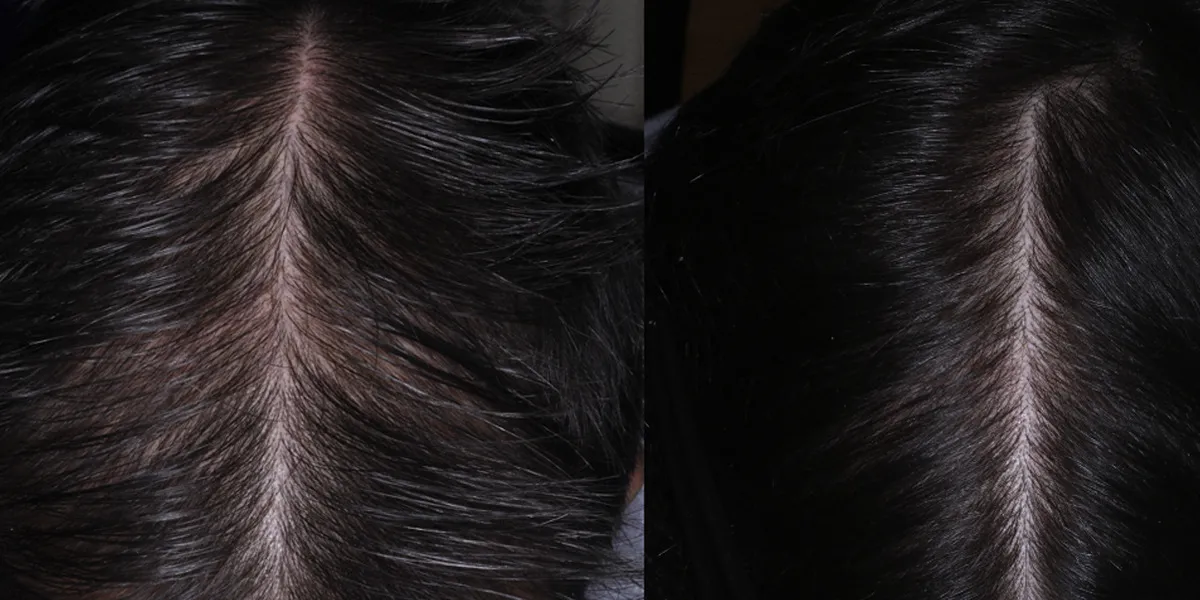
Female pattern baldness is a type of ongoing hair loss in women. It usually happens slowly over time. It mainly affects the hair on the top of your head and the center part. Over time, the part begins to appear wider.
Unlike many men, women usually do not go completely bald. But the hair becomes weaker, thinner, and softer. This is one of the most common types of female pattern baldness.
Doctors also say that without treatment, the hair usually does not grow back on its own.
What Does Female Pattern Baldness Look Like?
Most women notice things like:
- Hair thinning mostly on the top of the scalp
- A wider center hair part that sometimes looks like a Christmas tree shape
- The front hairline usually stays the same
- Hair slowly becomes finer and softer over time
This type of hair loss does not cause physical pain. Many women notice it more after menopause, but it can start earlier, too. Sometimes it even looks like male baldness in women because of the thinning pattern.
Why Does Female Pattern Baldness Happen?
Female pattern hair loss mostly happens because of genes and hormones. Let’s get into the details.
Genes Play a Big Role
If someone in your family has hair thinning, you may have a higher chance too. It can come from your mother’s side. It can come from your father’s side. It is like eye color or height. We do not choose it. We just inherit it.
Hormones also Affect Hair
Your body has both female and male hormones. Male hormones are called androgens. Some women have higher sensitivity to these hormones. When this happens, the hair follicles slowly shrink. When follicles shrink, the hair becomes thinner. It also grows shorter. Over time, the hair looks weaker and less dense.
Age Makes a Difference
Hair thinning often becomes more noticeable as we get older. Many women see more changes after menopause. This happens because hormone levels change at that time. So the balance in the body shifts, and hair reacts to it.
Stress Can Make It Worse
Stress does not usually cause female pattern baldness by itself. But it can speed it up. When you go through worry, illness, or emotional pressure, the hair cycle changes. So you may notice more shedding during those times.
Stages of Female Pattern Baldness (Sinclair Scale)

Doctors sometimes use something called the Sinclair Scale. It helps show how thinning changes over time.
- Stage 1 — Normal or very mild thinning
- Stage 2 — A small gap in the center part
- Stage 3 — A wider gap and thinning on both sides of the part
- Stage 4 — Thinning spreads toward the front
- Stage 5 — Advanced thinning and clear bald patches
Hair loss usually happens slowly, over years.
Does Female Pattern Baldness Get Worse?
Yes, female pattern hair loss usually continues over time without treatment. It moves slowly, but it rarely stops on its own. That is why treating baldness in females early is very important.
Can Hair Grow Back?
For most women, hair does not fully grow back on its own when Female Pattern Baldness happens, because the hair follicles slowly shrink and make thinner hair.
But there is good news, because treatment can slow the hair loss, sometimes help new hair grow, and protect the hair that is still there. So even though female balding sounds scary, you still have real options, and many women do see improvement.
Dermatology experts also say that the earlier you start treating baldness in females, the better your results usually are, because it is easier to protect hair that still exists than to bring back hair that is already gone.
How Do Doctors Diagnose Female Pattern Baldness?
A doctor or dermatologist may:
- Look closely at your scalp
- Ask about your health and stress levels
- Ask about your family’s hair history
- Check hormone levels
- Do blood tests if needed
- Sometimes, do a small scalp biopsy
This helps doctors make sure the hair loss is not caused by other problems like iron deficiency or thyroid issues.
What are the Treatment Options for Female Pattern Baldness?
Different treatments work for different women. Let’s talk about the most common options used for treating baldness in females.
Minoxidil (Rogaine)
This is the most common treatment for female pattern hair loss. It is available without a prescription. You apply it directly to your scalp.
It can:
- Slow hair loss
- Help regrow some hair
- Make hair thicker and stronger
But you must continue using it. If you stop, the hair loss usually returns.
Results usually take between 4 and 12 months.
Prescription Medicines
Doctors may suggest medicines such as:
- Spironolactone
- Finasteride (for selected women only)
- Ketoconazole shampoo
These help block the hormones that shrink hair follicles. Doctors must supervise these medicines because they are not suitable for everyone, especially during pregnancy.
Other Treatment Options
Some women also try:
- PRP injections (Platelet Rich Plasma)
- Low-level laser therapy
- Hair transplant surgery
- Cosmetic options like wigs or hair fibers
PRP and laser therapy may help some women, but results vary. Research is still growing in this area.
When Should You See a Doctor?
Please see a doctor if:
- Your hair is thinning
- You notice sudden heavy shedding
- You have bald patches
- Your scalp is painful or itchy
- You have acne or extra facial hair
- Your periods are irregular
Doctors can help you earlier and more effectively than waiting.
Is Female Pattern Baldness Permanent?
Yes. Without treatment, female pattern hair loss is usually permanent.
But with treatment, you can:
- Slow it down
- Protect the hair you still have
- Sometimes regrow hair
So taking action early really helps.
Besides, you can check out this guide to learn about the best shampoo and conditioner for hair growth and thinning hair.
Can Female Pattern Baldness Be Prevented?
There is no guaranteed way to fully prevent female balding. But you can support your hair health by doing simple things every day:
- Eat enough protein
- Get essential vitamins and minerals
- Sleep well and rest properly
- Reduce stress whenever possible
- Avoid harsh chemicals on your hair
- Treat health issues early
Gentle hair care and the right products also matter. Use shampoos and oils that are mild, sulfate-free, and gentle on your scalp. Avoid strong styling products or harsh chemicals that can damage your hair roots. If your hair feels dry or weak, nourishing oils and serums can keep it soft and protected.
At Salon Essentials LA, we always suggest choosing products that care for both your scalp and hair so your hair stays healthy in the long run.
For orders or guidance, call us at 5042144089 – we’re happy to help!
Wrapping Up on Female Pattern Baldness
If your hair is thinning, please remember this:
- You did not cause this.
- You are not alone.
- And there is real help available.
Start early. Talk to a professional. Be patient. Hair grows slowly, but progress happens.
And most important…
- You are still beautiful.
- With thick hair.
- With thin hair.
- With any hair.
FAQs
|